
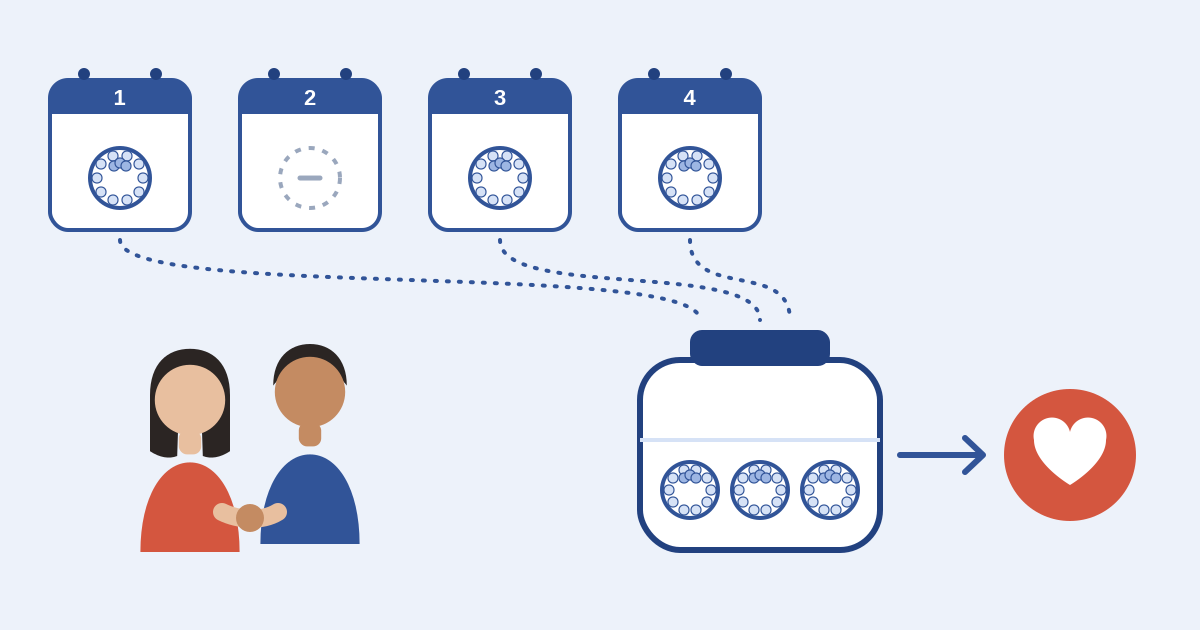
- A low ovarian reserve means few eggs in each cycle, not that pregnancy is impossible. The chances exist, but they are lower and often require several attempts.
- With a very low reserve, an “IVF attempt” is no longer a single cycle: it is often a series of mini-cycles. The strategy must be judged over the whole journey, not over a single cycle.
- Two strategies are possible: transfer after each successful egg collection (cycle by cycle), or accumulate several embryos before transferring. The choice is made together, according to your situation and your priorities.
“Your AMH is very low.” This sentence worries many women, often before they have even understood what it means. Between alarmist messages and promises that are too good to be true on social media, it is hard to find your way. This article explains what we know, with honest figures, and how we build a suitable strategy with you.
What does “low ovarian reserve” mean?
The ovarian reserve is the stock of follicles present in the ovaries. It is estimated by two tests: measuring AMH (anti-Müllerian hormone) in the blood, and the antral follicle count on ultrasound. The reserve is described as low when AMH is below about 1.1 ng/ml. Below about 0.3 ng/ml, it is described as very low.
Two points are important:
- AMH measures quantity, not quality. Egg quality depends mainly on age. With the same AMH, a 32-year-old woman has better chances than a 41-year-old woman.
- A low AMH does not prevent a natural pregnancy as long as you still have cycles: one egg a month is enough. Spontaneous pregnancies do in fact occur during IVF journeys.
Not all low reserves are alike
In our practice, we distinguish three situations. These are proposed markers to guide strategy, not an official classification:
Low reserve
AMH between 0.3 and 1.1 ng/ml, 3 to 5 follicles, regular cycles. We use the available cohort: conventional stimulation, most often cycle by cycle.
Very low reserve
AMH between 0.1 and 0.3 ng/ml, 1 to 2 follicles, cycles often short. Mild or conventional stimulation; cycle by cycle or pooling is discussed.
Extremely low reserve
AMH below 0.1 ng/ml, intermittent follicles, irregular cycles. Follicles are “captured” when they appear, preferably by pooling embryos.
What are the realistic chances?
It is important to know them before starting. Large studies show, in women under 42:
- with an AMH below 0.4 ng/ml, about 14% of women achieve a birth over all their attempts1;
- with an AMH below 0.2 ng/ml, about 21% achieve a clinical pregnancy, over all their attempts2;
- about 4 cycles in 10 are cancelled or yield no egg or embryo, compared with fewer than one in ten in the general population3.
The lower the AMH, the lower the chances, even within low reserves4. These figures do not tell you what will happen to you, but they allow you to decide with full knowledge.
“What if I were one of those who succeed?”
It is a legitimate question, and sometimes the answer is yes. But we all tend to think that our chances are better than other people's: this is called comparative optimism. Our role is to find the right balance between your hope, which is precious, and scientific rigour. A precise and transparent prognosis does not take away hope: it avoids false hope.
What can happen in each cycle
With very few follicles, each mini-cycle can stop at a different step:
- no follicle responds to stimulation;
- ovulation occurs before egg collection;
- the aspirated follicle contains no egg;
- the egg collected is not mature;
- the egg does not fertilise, or the embryo stops developing.
It is discouraging, but it is not a failure of the strategy. A cycle without an embryo does not mean the next one will be the same. We adapt each cycle to what the ultrasound shows: a monitored natural cycle if there is only one follicle, mild stimulation if there are two, conventional stimulation beyond that.
What has not been proven
Many treatments are offered to “increase the reserve”. Randomised trials and recent European guidelines are clear5,6,7:
- Injection of platelet-rich plasma (PRP) into the ovaries: no effect on births in randomised trials.
- DHEA: not recommended, inconsistent results.
- Testosterone and delayed start of stimulation: probably not recommended, in the absence of sufficient evidence.
- Coenzyme Q10: some encouraging results on the number of eggs, but no recommendation to date.
None of these treatments “recreates” follicles. It is better to devote your time and energy to an effective strategy.
Two strategies: cycle by cycle or embryo pooling
Cycle by cycle
- Transfer after each successful egg collection
- Faster chance of a first pregnancy
- Usually conventional stimulation
- May lead to repeated transfer failures
- High risk of giving up after a failure
Embryo pooling
- Several egg collections before transferring
- Builds up a reserve of frozen embryos
- Allows mild stimulation or natural cycles
- Requires a commitment before any transfer
- Often helps couples continue the journey
Why continuity matters
With a very low reserve, the first risk is not the failure of one cycle: it is stopping too early. In a large French study, one woman in four stopped after the first IVF failure, as did more than half of those who had obtained no egg or a single egg, without a transfer8. In addition, the longer the interval between two stimulations, the fewer eggs and blastocysts are collected9. This observation does not prove that the delay is the cause, but it suggests not waiting without a reason.
We studied 104 women aged 42 or under, with an AMH of 0.3 ng/ml or less, treated in our centre between 2017 and 2025 (data not yet published):
- The chances of a birth were comparable with both strategies: 19% cycle by cycle, 17% with pooling.
- Drop-out was more frequent cycle by cycle (62%) than with pooling (38%).
- Among the women who reached transfer, more than one in four (28%) had a baby. Five spontaneous pregnancies also occurred during the pooling journey.
This is an observational study of selected patients: it does not allow us to say that one strategy is better than the other.
Knowing when to stop
A journey with a very low reserve can be long. It is important to agree together, from the start, on milestones to take stock: for example after 42, after four successive cycles without an embryo, or if pooling does not succeed. Stopping is not giving up: it is sometimes the right decision, made in trust, with all the information.
Our approach
We start with an explanatory consultation: your reserve, your age, your realistic chances and the possible options. Then we choose the strategy together, cycle by cycle or pooling, taking your priorities into account: speed, cost, travel constraints, tolerance of failure. Each cycle is then adapted to what the ultrasound shows. If you live outside Tunis, monitoring can be done near your home, with your own doctor: we send you the protocol, and results received before 3 pm get a same-day reply.
Key takeaways
What helps
- Knowing your realistic chances before starting
- Judging the strategy over the whole journey
- Adapting each cycle to the number of follicles
- Not letting too much time pass between two cycles
- Agreeing together on milestones to take stock
What does not help
- Giving up after a single difficult cycle
- Ovarian PRP, DHEA and “miracle” treatments
- Believing that a low AMH makes any pregnancy impossible
- Promises of results without figures

Dr Mohamed Khrouf
Associate Professor of Obstetrics and Gynaecology, specialist in infertility and assisted reproduction. GynTunis practice and Fertillia Centre, Tunis.
This article provides general information based on the scientific evidence available at the date of publication. It does not replace the advice of your doctor, who takes your personal situation into account.
- Weghofer A et al. Live birth chances in women with extremely low-serum anti-Mullerian hormone levels. Human Reproduction, 2011.
- Kedem A et al. Outcome of immediate versus deferred IVF in women with extremely low AMH. PLoS One, 2013.
- Seifer DB et al. Women with declining ovarian reserve may demonstrate a decrease in day 3 FSH… Fertility and Sterility, 2016.
- Tal R et al. Cumulative live birth rates in women with diminished ovarian reserve: SART analysis. Journal of Clinical Endocrinology and Metabolism, 2024.
- Fang Y et al. Intraovarian platelet-rich plasma: meta-analysis of randomized trials. Frontiers in Endocrinology, 2026.
- Conforti A et al. Adjuvant treatments in poor responders: meta-analysis. Fertility and Sterility, 2025.
- ESHRE Guideline Group. Human Reproduction, 2026.
- Troude P et al. Medical factors associated with early IVF discontinuation. Reproductive BioMedicine Online, 2014.
- Ruffa A et al. Interval between consecutive ovarian stimulations and ovarian response. Journal of Assisted Reproduction and Genetics.