
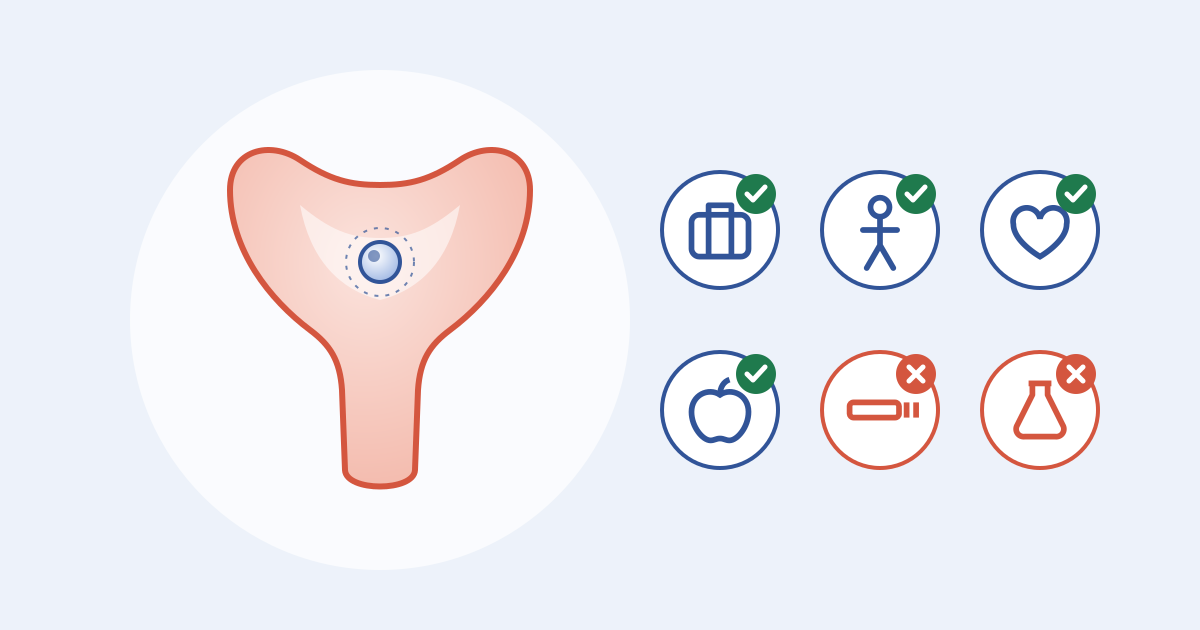
- Bed rest after a transfer does not increase the chances of pregnancy. You can get up straight away and return to normal life.
- No special diet is needed. What matters: avoid tobacco, alcohol and other toxic substances, and never stop your treatment without medical advice.
- Travelling on the same day or having sex does not prevent the embryo from implanting, unless your doctor has advised otherwise.
After an embryo transfer, the wait is often the most stressful part of the journey. Many couples look for something “extra” they could do to help the embryo attach, and receive conflicting advice from friends, family or the internet. Here is what the studies show, point by point.
The embryo cannot “fall out”
This is the most common fear. Yet the uterus is not an open cavity: its walls touch each other, and the embryo, barely visible to the naked eye, is placed between them in a thin layer of fluid. Getting up, walking, coughing, going to the toilet or climbing stairs does not move it.
Myths and reality
False. Several randomised trials and meta-analyses have compared bed rest with getting up immediately: none has shown any benefit of rest, whatever its duration1,2. A large analysis of 188 trials even concludes that prolonged rest, of more than 20 minutes, should not be recommended3. You can get up as soon as the transfer is over.
False. Normal daily and professional activity is compatible with implantation. Staying inactive brings no benefit and often feeds anxiety. Only very intense physical effort or contact sports are worth avoiding during this period, as a precaution.
False. No food, juice, herbal tea or “implantation” supplement has been proven to work. A balanced, usual diet is enough. If you were already taking folic acid, keep taking it.
True. Tobacco, alcohol and drugs should be avoided completely, from now on and throughout pregnancy. Also keep caffeine to a moderate level, and do not take any medicine without talking to your doctor or pharmacist.
False. You can go home the same day, by car, train or plane. Neither vibrations nor cabin pressure affect the embryo. On a long journey, drink regularly and get up to walk from time to time: hormone treatments slightly increase the risk of blood clots.
False, in most cases. Studies have not shown any harmful effect of intercourse around the time of transfer. Some even suggest a favourable effect of seminal fluid on the lining of the uterus4,5, although this effect on the number of births remains to be confirmed. Your doctor may, however, advise you to abstain in certain situations, for example in case of ovarian hyperstimulation or bleeding.
True, and essential. Progesterone and the other prescribed treatments support the lining of the uterus. Never stop them on your own initiative, even if you have light bleeding, before talking to your doctor.
And the pregnancy test?
Have the blood test on the date given by your team. A urine test done too early may be falsely negative, or falsely positive if you received an hCG hormone injection as the trigger. The wait is hard, but a reliable result spares you unnecessary emotions.
Key takeaways
You can
- Get up and walk as soon as the transfer is over
- Go back to work and your usual activities
- Travel on the same day
- Eat normally, with a balanced diet
- Have sex, unless your doctor advises otherwise
Avoid
- Tobacco, alcohol and drugs
- Medicines taken without medical advice
- Very intense effort and contact sports
- Stopping your treatment on your own
- Urine tests taken too early

Dr Mohamed Khrouf
Associate Professor of Obstetrics and Gynaecology, specialist in infertility and assisted reproduction. GynTunis practice and Fertillia Centre, Tunis.
This article provides general information based on the scientific evidence available at the date of publication. It does not replace the advice of your doctor, who takes your personal situation into account.
- Cozzolino M et al. Bed rest after an embryo transfer: a systematic review and meta-analysis. Archives of Gynecology and Obstetrics, 2019.
- Bar-Hava I et al. Immediate ambulation after embryo transfer: a prospective study. Fertility and Sterility, 2005.
- Craciunas L et al. Interventions performed in the context of embryo transfer: a network meta-analysis of 188 randomized trials. Human Reproduction Update, 2022.
- Hou JW et al. Impact of sexual intercourse on frozen-thawed embryo transfer outcomes: a randomized controlled trial. Contraception and Reproductive Medicine, 2023.
- Saccone G et al. Effectiveness of seminal plasma in in vitro fertilisation treatment: a systematic review and meta-analysis. BJOG, 2019.