
- A woman's age is the factor that weighs most on fertility, naturally as well as with IVF.
- The main reason: with age, a growing share of eggs, and therefore of embryos, carries an abnormal number of chromosomes. These embryos do not implant, or end in miscarriage.
- Neither IVF nor dietary supplements correct this effect of age. After 43, with one's own eggs, the chances become very low: it helps to talk about it frankly, and early enough.
A woman is born with a stock of eggs that is not renewed. Over the years this stock shrinks: this is the “ovarian reserve”. But above all, the quality of the remaining eggs changes. And it is this quality, far more than their number, that explains the fall in the chances of pregnancy.
What age changes in the egg
To produce a normal embryo, the egg must share out its chromosomes very precisely as it matures. With age, this sharing works less and less well. The result: a growing proportion of embryos has one chromosome too many or too few. This is called aneuploidy.
Most of these embryos do not implant. Others implant and then stop developing: this is the main cause of early miscarriages, which also become more frequent with age.
The figures, age by age
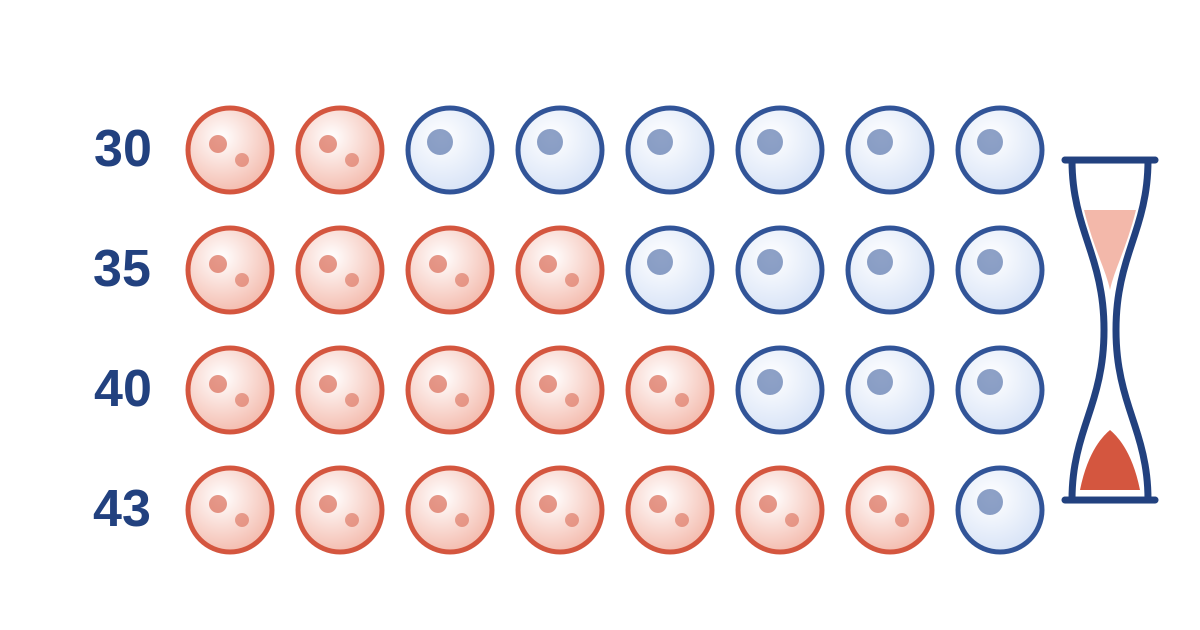
Share of embryos (blastocysts) carrying a chromosomal abnormality
Orders of magnitude from large series of genetic analyses of embryos1,2. Values vary from one woman to another.
In other words, around 30, about three embryos out of four have a normal number of chromosomes. Around 40, it is fewer than one in two. Around 43, only about one in six or seven.
Another figure illustrates this well: the proportion of women in whom no embryo from an IVF attempt is chromosomally normal is 2 to 6% between 26 and 37, but about one third at 42 and more than half at 441.
Chances of natural pregnancy per cycle
Approximate probability of conceiving in one cycle, with regular intercourse3,4.
So even at 30, pregnancy does not necessarily happen in the first month: about one chance in five per cycle. That is normal. But at 40, this chance is about four times lower.
And with IVF?
IVF makes it possible to obtain several eggs in a single cycle, instead of just one naturally. It therefore increases the number of possible “tries”. But it does not change the quality of each egg: a 42-year-old egg remains a 42-year-old egg, in the laboratory as in the body.
That is why the chances per IVF attempt fall with age, in the same way as natural fertility, and for the same reason.
After 43
With one's own eggs, the chances of a birth per attempt become very low after 43, in the order of a few per cent. The American Society for Reproductive Medicine describes a treatment with a 1 to 5% chance of birth per cycle as having a “very poor prognosis”, and one below 1% as “futile”5.
In this situation, further stimulation is usually not helpful. This is hard to hear, but it avoids exhausting oneself, physically, emotionally and financially, in attempts that have very little chance of success.
And dietary supplements?
Vitamins, antioxidants, coenzyme Q10, DHEA, melatonin… Many supplements are sold to “improve egg quality”. None has been shown to correct the effect of age. The large Cochrane review of antioxidants, covering 63 trials, concludes that we do not know whether they increase the number of births, because the evidence is of very low quality6.
These products do not rejuvenate eggs, and they are often an unnecessary expense. Only folic acid is still recommended before and in early pregnancy, not to improve fertility, but to prevent certain birth defects.
What can be done
- Do not delay seeing a doctor: after 12 months of trying before 35, after 6 months from 35, and without waiting after 38-40.
- Get tested as a couple: the man's age also plays a role, even if its effect is smaller.
- Consider fertility preservation if you wish to become pregnant later: egg freezing is all the more effective when done young.
- Act on what can be changed: smoking, weight, alcohol. They do not make up for age, but they make it worse.
Key takeaways
- With age, it is not only the number of eggs that falls, it is above all the share of chromosomally normal embryos.
- Around 30, about 1 embryo in 4 is abnormal; around 40, more than 1 in 2; around 43, about 6 in 7.
- IVF increases the number of eggs, not their quality.
- Vitamins and supplements do not correct the effect of age. Only folic acid is recommended, for the baby's health.
- After 43, with one's own eggs, the chances are very low: it is better to talk about it early and frankly.
Dr Mohamed Khrouf
Associate Professor of Obstetrics and Gynaecology, specialist in infertility and assisted reproduction. GynTunis practice and Fertillia Centre, Tunis.
This article provides general information based on the scientific evidence available at the date of publication. It does not replace the advice of your doctor, who takes your personal situation into account.
- Franasiak JM et al. The nature of aneuploidy with increasing age of the female partner: a review of 15,169 consecutive trophectoderm biopsies. Fertility and Sterility, 2014.
- Capalbo A et al. Cytogenetic constitution of human blastocysts: insights from comprehensive chromosome screening strategies. Human Reproduction Update, 2019.
- Manchester University NHS Foundation Trust. Age and Fertility, information patients, 2020.
- Steiner AZ, Jukic AM. Impact of female age and nulligravidity on fecundity in an older reproductive age cohort. Fertility and Sterility, 2016.
- Ethics Committee of the American Society for Reproductive Medicine. Fertility treatment when the prognosis is very poor or futile. Fertility and Sterility, 2019.
- Showell MG et al. Antioxidants for female subfertility. Cochrane Database of Systematic Reviews, 2020.