
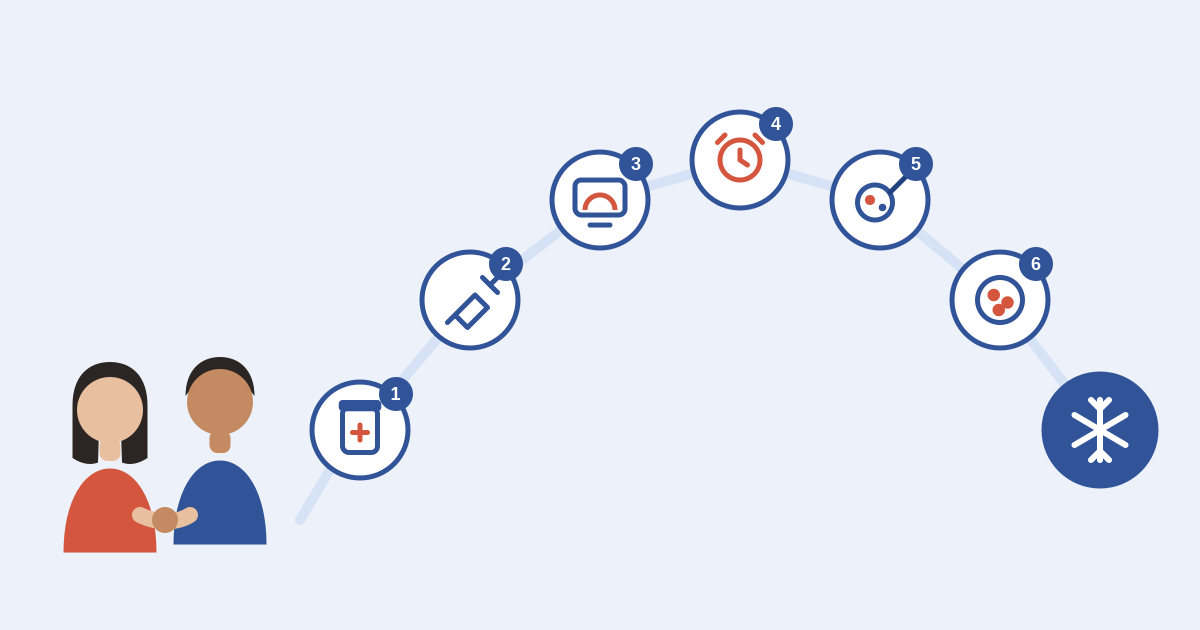
This protocol has been suggested to you either because your uterus is not yet ready to receive an embryo, or because genetic testing of your embryos is planned. All the embryos obtained are therefore frozen, and the transfer will take place later, in another cycle.
The first part of the journey, from stimulation to egg collection, is the same as for conventional IVF. The difference comes afterwards: there is no transfer during this cycle.
Tap a step to see the details.
1I prepare my medicinesBefore the cycle starts
Buy the prescribed medicines in advance, so that you have them from the first day. If you have any doubt about a product or a dose, ask before you start.
2I start the treatmentDay 1 or 2 of your period
- I call the practice on day 1 or 2 of my period to make an appointment. Day 1 is the day when red blood flow starts.
- I have my ultrasound on day 2 or 3 of the cycle.
- If everything is in order, I start my injections, as prescribed. Unless the doctor has asked you to start stimulation on another day of the cycle.
3Stimulation and monitoringFor 9 to 11 days
The injections are daily, under the skin, preferably at a fixed time. No dose may be missed: set a reminder on your phone.
About 4 days after starting, then every 2 to 3 days, I come for a check-up: ultrasound and blood test, on the same day. The blood test result must be ready the same day. At each check-up, the doctor prescribes the doses to inject until the next check-up and gives me the date of the next visit.
4The triggerLast step of stimulation
When the follicles are ready, I give a last injection, which triggers the final maturation of the eggs. The exact time is vital: egg collection is scheduled according to this time.
Set two alarms.
5Egg collectionTwo days after the trigger
It takes place at the Fertillia Centre, under anaesthesia. Come:
as a couplefastingwith an identity documentwith your marriage certificatewith your infectious disease screening results
Be on time.
6The laboratory report3 to 5 days after egg collection
The laboratory informs me whether it has obtained one or more embryos, which are frozen. I collect my report and contact the practice by email for the next steps.
The doctor then tells you whether another stimulation is needed, or whether the number of embryos obtained is sufficient. The transfer of the frozen embryos will take place in a later cycle: we will then explain how it is prepared.
After egg collection
Before leaving the clinic
You usually stay about 2 hours after egg collection. Before leaving, check that:
- you have received your prescription;
- the embryologist has called you to give you the total number of eggs and the number of mature eggs.
Once home, start the prescribed treatment.
The day after egg collection
The laboratory calls you to tell you how many eggs have been fertilised, then calls back 2 to 3 days later to tell you the number of embryos obtained. Make sure you have given a number where you can be reached.
What I may feel
Moderate pain, bloating or slight bleeding are usual.
Will every cycle lead to frozen embryos?
Not always.
- The follicles I see on the ultrasound are pockets of fluid, which contain an egg, or sometimes not.
- Not all eggs will necessarily be mature.
- Not all mature eggs will produce embryos.
Understand why, step by step →
What if I have questions in the meantime?
Monday 8 am to Saturday 12 noon.
Good luck!
Every step counts, and you are not alone. The whole team is here to support you.

Dr Mohamed Khrouf
Associate Professor of Obstetrics and Gynaecology, specialist in infertility and assisted reproduction. GynTunis practice and Fertillia Centre, Tunis.
This document describes the usual course of this journey in our team. Your protocol may be different: always follow the instructions and the prescription you have been given.